From 7 to 613 to 49: How Survival and Burden Give Way to Selfless Flourishing
Introduction: Numbers That Shape Faith
God has always spoken through both words and numbers. The design of creation itself carries numerical patterns: seven days of creation, twelve tribes, seventy nations, forty days of testing, fifty days of celebration. Numbers symbolize order, completion, and covenant rhythm.
Three numbers have shaped Jewish and Christian imagination in particular:
613 commandments (taryag mitzvot in Hebrew), representing the full scope of Torah. Rabbinic tradition counted 365 prohibitions (one for every day of the year) and 248 positive obligations (one for every limb and organ of the body). The symbolic claim was simple: every day and every part of life belongs to God.
Our 7 days of the week set the minimum and the 49 days (7 × 7), are representing cycles of wholeness. Seven days to complete creation, seven weeks from Passover to Pentecost, seven cycles of seven years leading to Jubilee. Forty-nine signals preparation; the fiftieth is always God’s climactic gift.
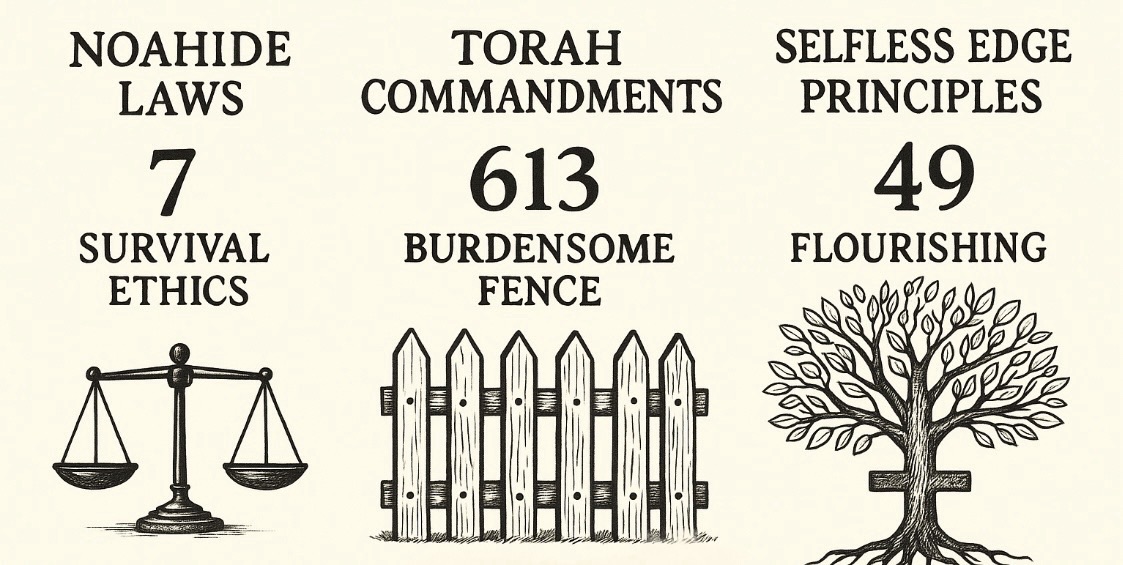
These three numbers are powerful. They each shape covenant imagination. But when it comes to discipleship in Christ, 613 is a burden while 49 is a blueprint and 7 is survival.
The 613 fenced holiness with endless commands. The 49 Selfless Edge™ principles mirror holiness with character-based reflection. The former polices boundaries; the latter nurtures transformation.
The Origin and Symbolism of the 613
The Torah never explicitly says there are 613 commandments. That number appears first in the Talmud (Makkot 23b–24a, 3rd century CE), where Rabbi Simlai declared:
“613 commandments were given to Moses at Sinai—365 negative, 248 positive.”
This symmetry was symbolic and elegant:
365 prohibitions = guardrails for each day of the solar year. 248 obligations = holiness embodied in every limb and organ of the body.
In the 12th century, Maimonides (Rambam) codified this in his Sefer HaMitzvot (“Book of the Commandments”), listing and categorizing the 613 in detail. His work shaped Jewish thought for centuries.
The logic was sound: if every day and every body part were oriented toward God, holiness would be comprehensive. But in practice, the 613 became not a pathway to God, but a fence around God’s Word.
The Fence Becomes a Burden
The rabbis spoke often of “building a fence around the Torah” (Pirkei Avot 1:1)—adding laws around laws to safeguard obedience. But the fence soon became more oppressive than protective.
Too numerous to carry. With the Temple destroyed in 70 CE, many commandments became impossible. Covenant identity was strained under rules that could not be kept. Obsessively policed. For example, Sabbath was meant as rest and delight. Instead, it was surrounded by sub-rules defining what “work” meant, leading to anxiety rather than peace. Socially weaponized. The law became a tool to separate: who was clean or unclean, worthy or unworthy, in or out.
The fence overshadowed the garden it was supposed to protect. Instead of joy, it produced anxiety. Instead of unity, it fostered exclusion.
Jesus directly confronted this:
“They tie up heavy, cumbersome loads and put them on other people’s shoulders, but they themselves are not willing to lift a finger.” (Matthew 23:4)
The 613 captured the breadth of obedience but missed its depth. They restrained sin but could not transform hearts.
Jesus and the Omer Journey
By contrast, the 49-day Omer journey offers a different vision of discipleship. Israel was commanded to count seven weeks from Passover to Shavuot (Leviticus 23:15–16). Agriculturally, it marked the shift from barley to wheat harvest. Spiritually, it symbolized the journey from Exodus deliverance to Sinai covenant.
Jesus lived this pattern perfectly:
Passover → His crucifixion as the Lamb of God. 49 days → His resurrection appearances, restoring Peter, opening the Scriptures, and preparing His disciples. Pentecost (Day 50) → The Spirit poured out, the law written on hearts.
This shows why 49 is enough. The number represents cycles of transformation that lead to Spirit-filled mission. The Omer wasn’t about checklist laws—it was about preparing character for covenant.
From a Fence to Mirror
Here lies the leader formation of the Selfless Edge™ framework.
613 commandments functioned as a fence. They told you where not to step. 49 principles function as mirrors. They show you where you actually stand.
Each principle is phrased not as a rigid command but as a reflection statement:
“I rarely practice this.” “I occasionally apply this.” “I’m growing in this area.” “I usually lead with this.” “This defines how I lead.”
The purpose isn’t to rank yourself, but to realign yourself. The 49 turn discipleship into reflection, repentance, and recalibration—mirrors that reveal where Christ is being formed in you.
The Five Pillars of Growth
The 49 principles are structured in five pillars, a progression of maturity:
Foundational Leadership Intelligence – wisdom, listening, humility.
Leadership Through Self-Mastery – clarity, restraint, stamina.
Character Is Destiny – patience, kindness, integrity.
From Inner Authority to Outer Impact – calm, counsel, ownership.
Transcendent Leadership – truth, reconciliation, surrender.
This design echoes the Omer journey. Each pillar builds on the last. Each principle deepens alignment. Together, they guide disciples through cycles of formation, shaping not outward conformity but inward character.
Why 49 Has To Be Enough
Why not 613? Because 49 is enough.
Cycles of maturity. Seven sevens represent wholeness. The fiftieth (Pentecost, Jubilee) is God’s gift of Spirit and freedom. The 49 prepare us, but grace completes us. Livable structure. Forty-nine principles provide breadth without overwhelm. They stretch without suffocating. Holiness in love. They train leaders not to separate from sinners but to sit with them, love them, and lead them toward Christ. Diagnostic clarity. The 49 provide a measurable framework for growth, allowing disciples to assess strengths and blind spots honestly.
The 613 can paralyze; the 49 mobilize. The 613 burden; the 49 balance.
Leadership Languages and Profiles
One of the great gifts of the Selfless Edge™ is its ability to reveal leadership languages.
Primary leadership language – the way you naturally lead, your “first voice.” For some it is vision-casting, for others protecting, for others building or reconciling. Supporting leadership languages – the secondary ways you can lead when needed. These require more energy but refine character.
The 49 principles serve as diagnostic checkpoints:
Which come naturally? These reveal your primary. Which stretch you? These expose your supporting.
Instead of trying to master 613 outward obligations, you discover your actual leadership profile: where you shine and where you must grow.
From Survival to Flourishing: Noahide vs. Selfless Edge
Before Sinai, after the flood, God gave humanity a basic covenant through Noah. Later summarized as the Seven Noahide Laws, these are:
Do not worship idols. Do not blaspheme God. Do not murder. Do not commit sexual immorality. Do not steal. Do not eat flesh torn from a living animal. Establish courts of justice.
These were not lofty ideals. They were survival ethics—the bare minimum required for civilization not to collapse.
But survival is not the same as discipleship.
You can avoid murder yet harbor hatred. You can avoid theft yet live in greed. You can honor courts yet refuse forgiveness.
The Noahide laws stop the bleeding but don’t heal the wound. They restrain evil but don’t cultivate holiness.
Jesus raised the standard:
Not just “Do not murder” but “Do not hate” (Matthew 5:21–22). Not just “Do not commit adultery” but “Do not lust” (Matthew 5:27–28). Not just “Honor justice” but “Forgive seventy times seven” (Matthew 18:22).
The difference is survival vs. flourishing.
The 49 principles call disciples beyond restraint into wholeness.
Noahide says: don’t steal. Selfless Edge says: steward generously.
Noahide says: don’t murder. Selfless Edge says: lift and protect others.
Noahide says: uphold justice. Selfless Edge says: reconcile enemies, practice mercy.
Leadership application:
A Noahide leader prevents collapse. A Selfless Edge leader cultivates harmony and renewal.
Survival says: “Don’t make it worse.”
Flourishing says: “Make it whole.”
A Parable: The Two Yokes
Two oxen walk together. One bears a yoke with 613 notches, each a rule. The weight is crushing; the ox stumbles, weary before the day’s work begins.
The other bears a yoke with 49 balanced grooves. It guides but does not crush. The ox walks steadily, plows deeply, and produces fruit.
This is what Jesus meant when He said:
“My yoke is easy and my burden is light.” (Matthew 11:30)
His yoke is not lawlessness. It is the 49 rhythms of selfless love.
From Fence to Formation, Survival to Flourishing
The 7 Noahide laws gave humanity survival.
The 613 mitzvot gave Israel identity.
But only Jesus gives transformation.
The 49 principles of Selfless Edge™ mirror the Omer journey, leading disciples through cycles of clarity, discipline, character, impact, and transcendence. They are not lighter than 613—they are sharper. They shift discipleship from fence to mirror, from burden to rhythm, from tally to transformation.
They are enough because they prepare leaders for mission. They are enough because they form primary and supporting languages. They are enough because they move us from survival to flourishing.
In short: 49 isn’t less than 613. It is the Jubilee of character—the fullness of love made livable.

Wisdom to Remember
“It is for freedom that Christ has set us free. Stand firm, then, and do not let yourselves be burdened again by a yoke of slavery.” — Galatians 5:1
Take your assessment: https://gmscharity.org/self-r1/