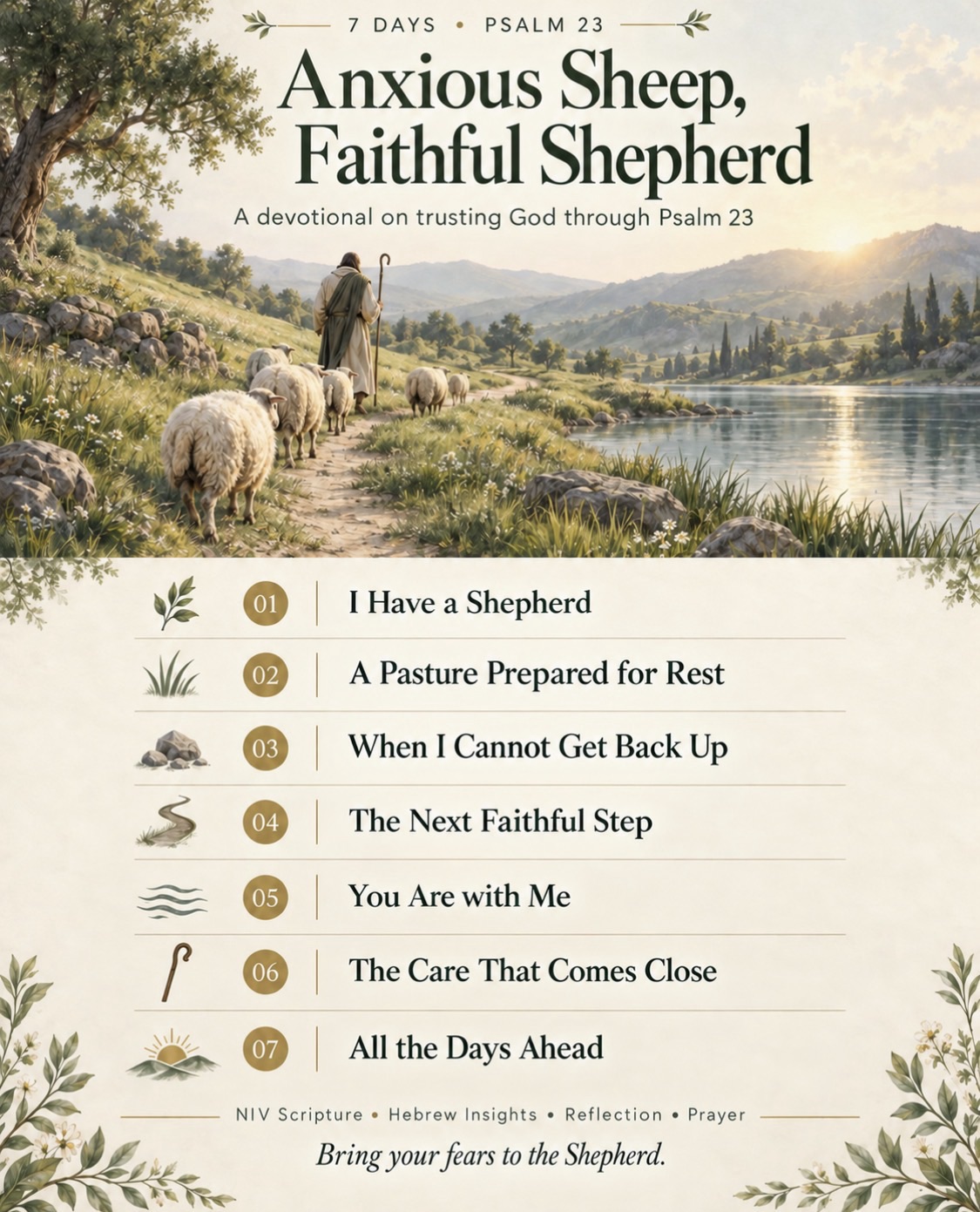
A Seven-Day Devotional on Trusting God through Psalm 23
How to Use These Seven Days
Welcome
My name is J. A. Tomlinson. I wrote this study for people who are tired from being responsible, and I have been one of them. On Day Two you will read a little of my own story. I am also the author of The Cross of Selfless Leadership, and the last page of this study explains how the two fit together.
Sheep are anxious animals. They are prey, and watchfulness keeps them alive. Psalm 23 was written by a man who had worked as a shepherd, and in it he takes the place of the sheep.
Many of us live the way sheep do. We watch, we check, we prepare, and we are tired. This study does not promise that seven days will end your anxiety. It shows you, one line of the psalm at a time, where to take it.
Begin with the psalm
Before Day One, read all of Psalm 23. It takes one minute.
Read all of Psalm 23 (NIV, Bible Gateway)
The rhythm
One day at a time, about fifteen minutes. Each day begins with the verse and one question about what the text says. Then come an opening thought, a note on the Hebrew, and a Gospel passage to read beside that line of the psalm. The day ends with a Day Anchor: one question, one action, one prayer. If you only have five minutes, read the verse and do the Anchor.
If you miss a day
Continue from the day you missed. You do not need to catch up, and you do not need to do two days in one. Guilt is not a spiritual discipline.
If you do this with a group
Read each day on your own, then meet to talk about the Day Anchor questions. Anyone may pass on any question. Do not press people to share private struggles, and respect the privacy of what is shared. If someone says something that suggests they or another person may be in danger, help them reach a pastor, a doctor, or emergency services.
If you are not sure what you believe
Read it anyway. The psalm describes something every person knows: the need to be looked after by someone stronger. Pray the prayers as truthfully as you can, even if they begin with “If You are there.”
A word about anxiety
Some anxiety needs more than a devotional. If fear is affecting your sleep, your health, or your ability to work, talk to a doctor or a counselor. Asking for that help is an act of faith. This study is not a substitute for pastoral, counseling, or medical care.
About the sheep
The descriptions of sheep in this study come from modern sheep farming. I owe several of them, including the cast sheep on Day Three and the nasal fly on Day Six, to W. Phillip Keller, who kept sheep for years before he wrote A Shepherd Looks at Psalm 23 (Zondervan, 1970). They are illustrations. The study does not claim that David had each of these practices in mind, and it tries to keep the meaning of a Hebrew word separate from the devotional thought built on it. Find A Shepherd Looks at Psalm 23
About the Bible text
The verse for each day is quoted from the New International Version. To read a whole chapter, use your own Bible or follow the links on this page to the New International Version at Bible Gateway.
Day One: I Have a Shepherd
The need today: provision
Scripture
“The LORD is my shepherd, I lack nothing.”
Look at the text: What two things does David say in this verse, and which one does he say first?
Opening Thought
A sheep lifts its head at an unfamiliar sound. A dog appears at the edge of the field, and the whole flock moves away. Sheep are prey animals, and watchfulness keeps them alive. A good shepherd knows this and handles them with care.
You may know that watchfulness from the inside. A short message arrives and you wonder whether someone is angry. The phone rings late and you expect bad news. A parent checks the locked door for the third time. A manager sends one more message at eleven at night. So you check again and plan further ahead, because people depend on you, and you believe that enough preparation will finally make you feel safe. By night you are tired from worrying about a day that has not come yet.
Psalm 23 begins with a relationship. David does not describe his circumstances. He says who is looking after him. You still have responsibilities, and some situations will stay hard. You can do today’s work and leave with God what is beyond your strength. Begin with the need you keep trying to manage alone. You were never built to be your own shepherd.
Hebrew Insight
Ro’i (רעי) means “my shepherd.” It comes from ra’ah, the verb for tending and feeding a flock, and the ending makes it personal: this shepherd is mine. Lo echsar (לא אחסר) means “I will not lack.” The weight of the sentence is on the Shepherd who provides. The sheep makes no claim to be self-sufficient. David can admit real needs because he trusts the One who meets them. When you pray today, stay with the word “my.” The Shepherd’s care reaches your particular life.
Alongside the Gospels
Jesus told His disciples not to worry about food or clothing, and He gave them a reason: your Father knows that you need these things. Then He called them what David called himself. He named them a little flock, told them not to be afraid, and said the Father is pleased to give them the kingdom. Jesus did not shame anxious people. He told them who was looking after them.
Day 1 Anchor
One question: What need do you keep trying to manage alone?
One action: Write that need on paper in one sentence and pray about it. Then put the paper away until tomorrow. If the worry returns, pray about it again.
One prayer: Lord, You are my Shepherd, and You know the need I have been managing alone. Help me do today’s work and leave the outcome with You.
Tomorrow: green pastures, quiet waters, and why rest is hard for anxious people.
Day Two: A Pasture Prepared for Rest
The need today: rest
Scripture
“He makes me lie down in green pastures, he leads me beside quiet waters,”
Look at the text: What actions does the Shepherd perform in this verse?
Opening Thought
I used to be proud of how tired I was. For seven years I delivered newspapers at 3 a.m. and sat down at a finance desk by 8 a.m. I planned to rest when the work was done. The work was never done, and I became irritable, anxious, and numb.
A shepherd does not wait for the sheep to finish. A green field looks peaceful from a distance, and the shepherd looks closer. Is there enough good forage? Are harmful plants growing in the grass? Can the flock reach water safely? Sheep can swim, but strong currents and steep banks can kill them, so he chooses a still place for them to drink. The pasture is inspected before the sheep lie down in it.
Anxious people postpone rest until every concern is settled. That moment keeps moving away, and meanwhile the body tires and patience runs short. Look at what is under your restlessness today. You may need sleep, a meal, practical help, or ten minutes of prayer without a phone. Sometimes the obstacle is outside you: a shift with no one to cover it, a child who cannot be left alone, an employer who expects an answer at night. Rest may need someone else’s cooperation. Your limits matter to God.
Hebrew Insight
Menuchot (מנחות), from menuchah, means rest or resting places. The phrase mei menuchot can be read as “waters of rest.” Yarbitseni (ירביצני) means “he makes me lie down.” The verb is causative: the Shepherd causes the rest. He brings the sheep to a place where rest is possible, and He provides what they need there. Ask a practical question: what rest is within reach today, and what would it take to accept it? It may take your own decision, someone’s help, or a change in what is expected of you.
Alongside the Gospels
The disciples came back from their work so busy that they had no time to eat. Jesus said, “Come with me by yourselves to a quiet place and get some rest” (Mark 6:31). A crowd followed them anyway. Mark says Jesus had compassion on the people because they were like sheep without a shepherd. Then He had everyone sit down on the green grass, and He fed them. Anyone who knows Psalm 23 will recognize the scene.
Day 2 Anchor
One question: What are you waiting to finish before you let yourself rest?
One action: Decide on a period of rest you can keep today: an hour if you can, fifteen minutes if you cannot. Then ask what it requires. Is it your own decision, someone’s help, or a change in what is expected of you? If it requires help, ask for it.
One prayer: Father, You know how tired I am. Lead me to the rest I need, show me what help to ask for, and teach me to trust You while I rest.
Tomorrow: what the Shepherd does when you cannot get back up.
Day Three: When I Cannot Get Back Up
The need today: restoration
Scripture
“he refreshes my soul.”
Look at the text: Who does the restoring in this line, and what is restored?
Opening Thought
Sometimes a sheep rolls onto its back and cannot turn over. Shepherds call this a cast sheep. It may kick with its legs in the air for hours and go nowhere. Left alone, it can die. Someone has to notice, roll it upright, and hold it steady until its legs work again. Its own effort is not enough.
You may know what that is like. Grief interrupts the routines that gave your days order. Exhaustion makes small decisions feel impossible. Failure makes you embarrassed to face the people who relied on you. You tell yourself to get up and do better, and then you feel ashamed when you still cannot. The sheep is held down by its own weight. People are held down by many things: illness, too few resources, an unsafe relationship. Shame adds to each of them, because it makes asking for help harder.
The Shepherd’s care makes room for asking. Restoration may come through prayer, through rest, through a truthful conversation, or through a doctor or counselor. Accepting any of these is an act of faith. Tell God where you are stuck. Then tell one trustworthy person what support you need, and let that person help you stand.
Hebrew Insight
Yeshovev (ישובב), from the root shuv, means to restore or bring back. Nafshi (נפשי) means “my soul” or “my life.” Its base word, nephesh, refers to the whole living person, body and mind included. When David says that God restores his soul, he means all of himself. The cast sheep is an illustration of needing help. The Hebrew does not describe a rescue technique. Let this phrase widen your prayer to include the physical and emotional needs you have been treating as unimportant.
Alongside the Gospels
Religious leaders criticized Jesus for welcoming sinners and eating with them. He answered with a story. A shepherd with a hundred sheep loses one of them. He leaves the ninety-nine, searches until he finds the lost one, and carries it home on his shoulders. Then he calls his friends and neighbors to celebrate. Jesus explains the story Himself: there is joy in heaven over one sinner who repents.
The parable is first about God’s joy in bringing back people who have wandered from Him. Exhaustion is not a sin, and neither is an anxiety disorder, so do not read your tiredness as something to repent of. The story still shows you the character of the Shepherd. He goes looking. He carries the sheep home. He is glad to do it.
Day 3 Anchor
One question: Who could you tell this week that you cannot get up alone?
One action: Send one message today to a trustworthy person. Say what you need in one sentence.
One prayer: Lord, restore me where I have lost strength and hope. Give me courage to ask for help, and patience with the pace of recovery.
Tomorrow: guidance for the next step, whether or not you feel restored yet.
Day Four: The Next Faithful Step
The need today: guidance
Scripture
“He guides me along the right paths for his name’s sake.”
Look at the text: What reason does David give for the Shepherd’s guidance?
Opening Thought
Anxiety makes uncertainty feel urgent. You want to see the entire route before you take one step. You review each option and imagine every consequence, hoping that enough thinking will remove the possibility of regret. Often it only keeps you standing still, even when the next responsibility is clear.
Picture a flock crossing unfamiliar ground. A patch of grass draws one sheep to the side. A narrow gap in the rocks looks worth exploring. The animal responds to whatever is closest. The shepherd is thinking about the route, the terrain, and where the flock will find water by nightfall. A sheep pays attention to what is near. The shepherd has to think about the whole day.
You cannot settle the whole future today. You can tell the truth, keep a commitment, ask for sound advice, or make the phone call you have been avoiding. Following the Shepherd takes willingness as well as reassurance. There may be a habit to change or a wrong to admit. Ask for wisdom about the decision in front of you, then act on what you already understand.
Hebrew Insight
Ma’gelei tsedeq (מעגלי צדק) is usually translated “right paths” or “paths of righteousness.” The word ma’gal means a track, such as the marks left by cart wheels, and the Bible often uses it for the course of a person’s life. Tsedeq adds the idea of what is right. Shem (שם), “name,” carries the sense of character and reputation. God guides in a way that is consistent with who He is.
Alongside the Gospels
Jesus described how a shepherd leads. He calls his own sheep by name and brings them out. Then he goes ahead of them, and they follow because they know his voice. They will not follow a stranger, because they do not recognize a stranger’s voice. Following Jesus depends on knowing His voice, and you learn it from His teaching. When the next step is unclear, begin with what He has plainly said. Tell the truth. Keep your word. Forgive. Leave tomorrow’s trouble for tomorrow.
Day 4 Anchor
One question: What decision have you delayed because you want certainty about every outcome?
One action: Choose the smallest next step in that decision and do it before the day ends.
One prayer: Shepherd, give me wisdom where the way is unclear and willingness where I already know what to do. I will take the next step and trust Your character with the rest.
Tomorrow: the path goes through a dark valley, and David begins speaking to God directly.
Day Five: You Are with Me
The need today: presence
Scripture
“Even though I walk through the darkest valley, I will fear no evil, for you are with me; your rod and your staff, they comfort me.”
Look at the text: Where does David stop speaking about God and begin speaking to Him?
Opening Thought
The valley is in the same psalm as the green pasture. Being led by the Shepherd does not mean every part of the road will feel safe. A diagnosis, a funeral, a lost job, or a relationship in crisis can change an ordinary day. Sometimes the fear is harder to explain. It follows you even when everything looks manageable from the outside.
In the picture David paints, the shepherd goes into that ground with the sheep. He carries a rod to protect them and a staff to guide and steady them. The sheep are comforted because the shepherd is near and knows how to use both.
David shows you where to take the fear. His confidence becomes a prayer spoken to God in the middle of the valley. You can do the same without hiding how frightened you are. Ask for protection. Accept His guidance. Reach for the support you need. You may not know how long this valley is. You can still speak to the One who is walking through it with you.
Hebrew Insight
Tsalmavet (צלמות) describes deep darkness, and it is traditionally translated “shadow of death.” The word covers every kind of dark place, including the fear of dying. Then comes attah immadi (אתה עמדי): “you are with me.” Notice the change. Until now David has been speaking about God. Here he turns and speaks to Him. The grammar moves from description to conversation at the point where the danger is greatest. When your way is unclear, do the same. Turn your description of the fear into words spoken directly to the Shepherd.
Alongside the Gospels
On the night before He died, Jesus went to a garden called Gethsemane to pray. He told His closest friends that He was deeply distressed, and He asked them to stay near and keep watch. Then He spoke to His Father directly. He asked for the suffering to be taken away, and He entrusted Himself to the Father’s will. Jesus has been in the darkest valley. He spoke openly about His anguish there, and He asked friends to stay close. You are allowed to do both.
Day 5 Anchor
One question: What feels like a dark valley in your life right now?
One action: Write a prayer of three sentences about it. Begin with the words “You are with me.”
One prayer: Lord, You are with me in this frightening place. Give me courage for the next step, and remind me of Your presence when the fear rises again.
Tomorrow: the Shepherd sets a table while the enemies are still present.
Day Six: A Table in the Presence of Enemies
The need today: close attention
Scripture
“You prepare a table before me in the presence of my enemies. You anoint my head with oil; my cup overflows.”
Look at the text: What remains unresolved while the host provides?
Opening Thought
A shepherd’s care includes small things. A tiny fly can torment a sheep. The female deposits larvae in and around the nostrils, and the animal sneezes, shakes its head, and cannot graze in peace. A good shepherd notices the distress, comes close, and treats it. Some of the worst suffering in a flock comes from what is small enough to overlook.
Then David changes the picture. Verse 5 moves from the field to a table. The host prepares a meal, anoints the guest’s head with oil, and fills the cup until it overflows. He does all of this while the enemies are still watching. The threat has not been removed. The meal happens anyway.
You may recognize this. You keep functioning while something painful goes unattended: an old injury to your trust that makes every relationship feel risky, a worry that wakes you at three in the morning, a hurt you decided was too small to mention. God does not wait for the enemies to leave before He sets the table. Tell Him where it hurts, and do not make it smaller than it is. Ask for healing and for wise help. Then sit down and receive what He has already prepared. One caution belongs here. Receiving God’s care during a conflict does not mean you must stay in danger. If a person is unsafe, you may keep your distance, and you should ask for help.
Hebrew Insight
Dishanta (דשנת), from dashen, is the verb translated “you anoint.” It describes refreshing the head with oil, a gesture of honor and welcome offered to a guest. Revayah (רויה), used of the cup, means fullness, more than enough. Together these words describe generous, personal hospitality. They do not name a medical remedy or promise instant recovery from every illness. They do insist on the setting: the enemies are present, and the cup overflows. You can be cared for, and you can give thanks, while some things remain unresolved.
Alongside the Gospels
At His last meal before the cross, Jesus knew that one of the men at the table would betray Him. He got up, tied a towel around His waist, and washed His disciples’ feet. Judas was still in the room. John does not describe a calm Jesus. He says that Jesus was troubled in spirit when He spoke about the betrayal. John also says that Jesus, having loved His own, loved them to the end. On the same evening He was distressed and He kept serving. Being troubled did not stop Him from loving. For you, love on a hard day may look different. It can mean accepting help, resting, or keeping a boundary with someone who is unsafe.
Day 6 Anchor
One question: What hurt or repeated worry have you been dismissing because you can still function?
One action: Before your next meal, thank God for three things that are already on the table, with the difficulty still unresolved.
One prayer: Father, You know where I hurt, including the places I have called too small to mention. Teach me to sit at Your table while my enemies are still in view.
Tomorrow: what follows you into the days ahead, and where the psalm ends.
Day Seven: All the Days Ahead
The need today: belonging
Scripture
“Surely your goodness and love will follow me all the days of my life, and I will dwell in the house of the LORD forever.”
Look at the text: What does David expect to accompany him, and where does he expect to live?
Opening Thought
A shepherd’s work does not end with one good day. The sheep will need fresh water again tomorrow. The pasture will need checking. An injured animal will need another look. Care is daily work, and the same needs return.
This week you have looked at six needs: provision, rest, restoration, guidance, presence, and close attention. Tomorrow will bring one of them back. You may return to the prayer from Day Two, or ask again for help you hoped you would no longer need. Needing help again does not exhaust God’s patience.
The psalm ends with a home. David expects goodness and love to follow him, and he expects to live in the house of the LORD. The Shepherd does more than supply what you need. He keeps you with Him. You belong to God before you are useful to anyone, and His care for you does not depend on what it produces.
Someone probably depends on you: a family, a team, a classroom, a congregation. Anxiety does not disqualify you from caring for them, and many anxious people lead with great care. It is worth asking whether worry is showing in particular habits: repeated checking, a short temper, a decision you keep holding back, help you refuse. You can look at any of these with God and with someone you trust. You do not have to finish this study feeling fearless. You can finish knowing where to bring your fear. Which line of the psalm do you need most tomorrow?
Hebrew Insight
Chesed (חסד), translated “love” in this verse, is faithful, loyal, covenant love. Yirdefuni (ירדפוני) comes from radaf, “to pursue.” Many translations say “follow,” but the verb is more active than that. A sheep spends its life watching for what might be chasing it. David says that what is chasing him is God’s goodness and faithful love. Carry that into tomorrow: whatever else is behind you, His care is closer.
Alongside the Gospels
In John 10 Jesus says, “I am the good shepherd. The good shepherd lays down his life for the sheep” (John 10:11). Christians read Psalm 23 in that light. The Shepherd David trusted has a face and a voice. Jesus says that His sheep hear His voice, that He gives them eternal life, and that no one can take them out of His hand. He has walked into death for you and risen again. “All the days of my life” is safe with Him.
Day 7 Anchor
One question: When you imagine what is following you into tomorrow, what comes to mind first?
One action: Choose one line of Psalm 23 and put it where you will see it tomorrow morning.
One prayer: Lord, thank You for caring for me through repeated needs. I place the days ahead in Your care. Teach me to walk with You one day at a time.
Keep bringing your fears to the Shepherd. His care reaches the days you have not yet lived.
Where this study sits
Before you go on
You do not need to finish this study less anxious than you began. These three questions are for reflection, and no one is grading the answers. What did you notice this week? What is still difficult? Which one practice from the seven days do you want to keep?
You may stop here. If the most useful thing you can do now is read Psalm 23 again tomorrow, do that.
If you want one next step
The Cross of Selfless Leadership: A 10-Day Spiritual Reboot for Leaders, by J. A. Tomlinson. These seven days were about receiving care. The ten days of the book examine how you carry responsibility for other people: what you serve, whether you tell the truth, whether you rest, and whether you keep a promise when it becomes costly. It is written for the person everyone relies on. Day Four of the book, on rest, continues Day Two of this study.
Continue with The Cross of Selfless Leadership
The wider work, in plain language
The book belongs to a wider body of work called the Load-Bearing Leadership System. Its idea is simple. How well a person carries responsibility depends on two things: the person, and the conditions that person works in, such as workload, clear roles, and support. Good people can break inside bad structures, and good structures cannot replace personal integrity. The system helps you tell apart what you need to change in yourself, what needs to change around you, and where both matter.
If you want a structured reflection
DIAL Lite is a free self-assessment about how you lead and the structure you lead within. It is directional and nonclinical. It is not a validated instrument or a personality test, and its results are a starting point for reflection, never a verdict. One of its ten profiles is named The Shepherd. In that tool the word describes a pattern of leadership: care, safety, and trust under strain. It is not a spiritual office, and it is not the Shepherd of this psalm. Open DIAL Lite
If you want more of the shepherd’s world
W. Phillip Keller’s A Shepherd Looks at Psalm 23 goes through the psalm line by line from the experience of a man who kept sheep. Several illustrations in this study come from his book, and it rewards slow reading. Find A Shepherd Looks at Psalm 23
Additional resources
The 49-Day Journey is a free daily reading on personal formation, one principle a day. Open the 49-Day Journey
DIAL Community is free for churches, nonprofits, and lodges through Global Mission Support. Visit gmscharity.org
There is no hurry with any of this. The Shepherd’s care does not wait for you to take a next step.
Scripture quotations taken from The Holy Bible, New International Version®, NIV®. Copyright © 1973, 1978, 1984, 2011 by Biblica, Inc.® Used with permission. All rights reserved worldwide.